
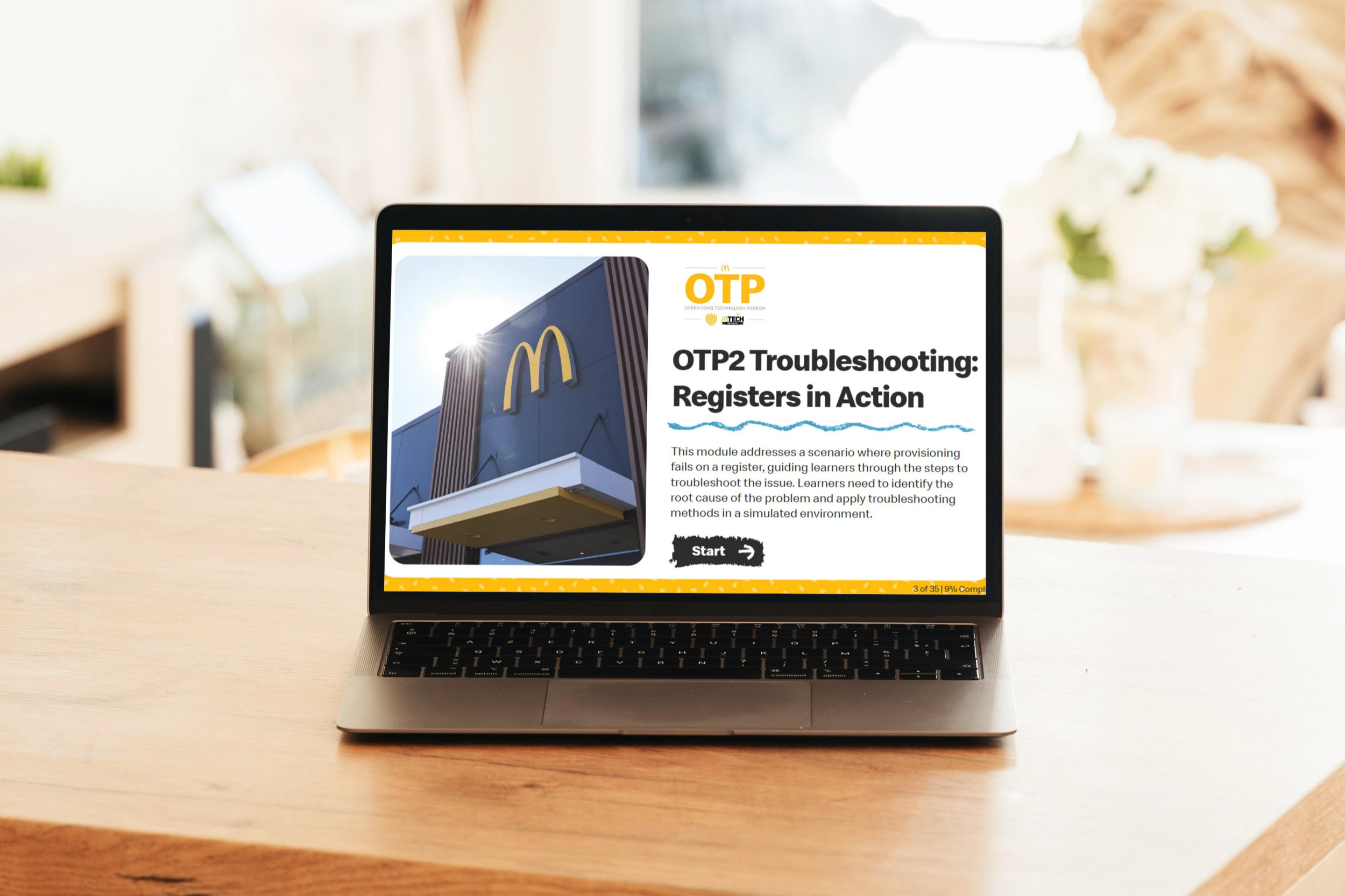
Registers in Action
This performance-based eLearning module is part of a course for restaurant technology employees. Learners navigate a branching troubleshooting scenario that simulates real-world technical issues encountered in restaurant environments.
Audience: McDonald’s technology employees enrolled in the Level 2 course.
My Responsibilities: Lead Instructional Design (SME collaboration, outlining, storyboarding, graphic and development collaboration, reviewing)
Tools Used: Microsoft Word, MindMeister, Snagit, Smartsheet
Design Intent
This module was designed as part of a larger course to support restaurant technology employees develop real-world troubleshooting skills. Because these skills are best built through experience rather than content recall, the learning experience was grounded in experiential learning principles and delivered through an instructional branching scenario.
Learners navigated realistic decision points, experienced the consequences of their choices, and were given opportunities to recover and try again, mirroring how troubleshooting unfolds in live restaurant environments while remaining risk-free.
This project also represented a shift in how learning experiences were designed at the company, as it was the first branching module, requiring innovative approaches to design, SME collaboration, and development handoff.
Designing in Tandem with SMEs
This module was designed through close, structured collaboration with SMEs. We began by identifying the underlying problem learners ultimately needed to resolve, then worked backward to determine how an employee might realistically uncover and fix it through a series of troubleshooting decisions.
Using an action-consequence flow diagram to visually capture our thinking, I guided SMEs through each step of the troubleshooting process by asking targeted questions such as:
“What is the next action someone should take?”
“What might they realistically do instead?”
“How often does that mistake happen, and what would be the consequence?”

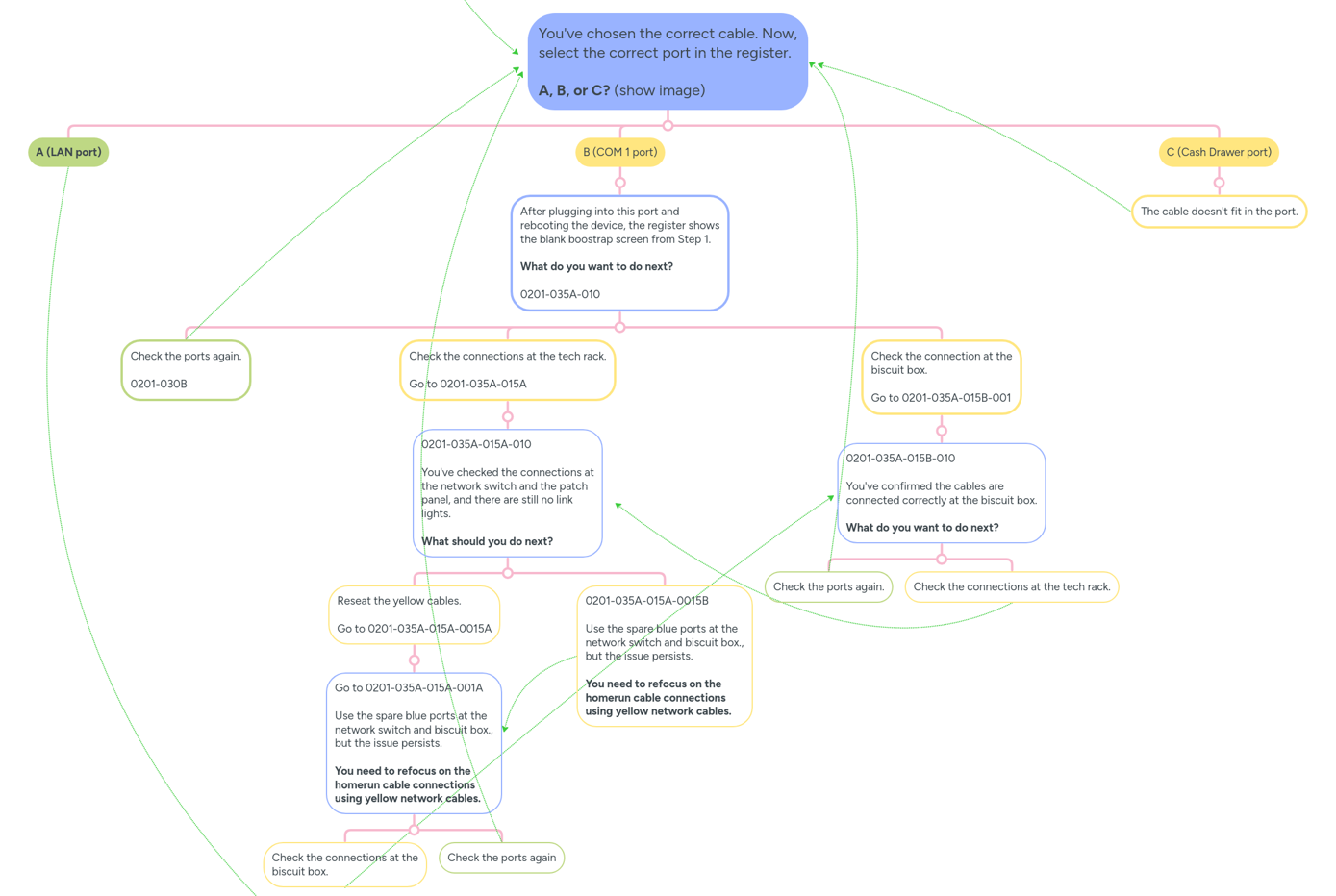
This approach kept conversations grounded in what actually happens in the restaurants, including common missteps, how devices respond, and what an employee would see and do next. Not every decision led to a fully separate path. Some mistakes would be quickly resolved and return learners to a previous step, while others led to additional decision points and extended troubleshooting paths.
As a team, we also made intentional decisions about where branching should stop and when learners should be brought back on track, being mindful of seat time, budget, and client expectations.
Insights from these sessions, along with reference materials provided by the SMEs, directly informed the design document and storyboard.
Design Document
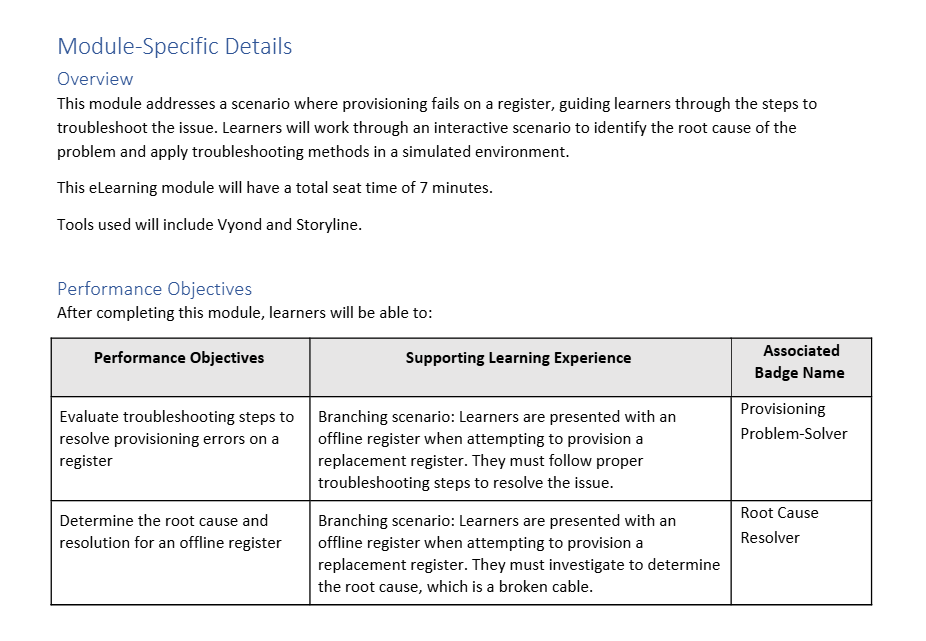
I created a design document to translate the action–consequence flow and SME input into a clear, high-level plan for the module. The document outlined the learner experience, performance objectives, and the specific decision-based interactions learners would engage in.
The design document went through three structured rounds of review with a senior instructional designer, SMEs, and a copy editor. Throughout these reviews, I synthesized feedback, clarified questions, and refined the document to ensure the scope, accuracy, and application of adult learning principles were solidified.
Storyboard & Branching Standards
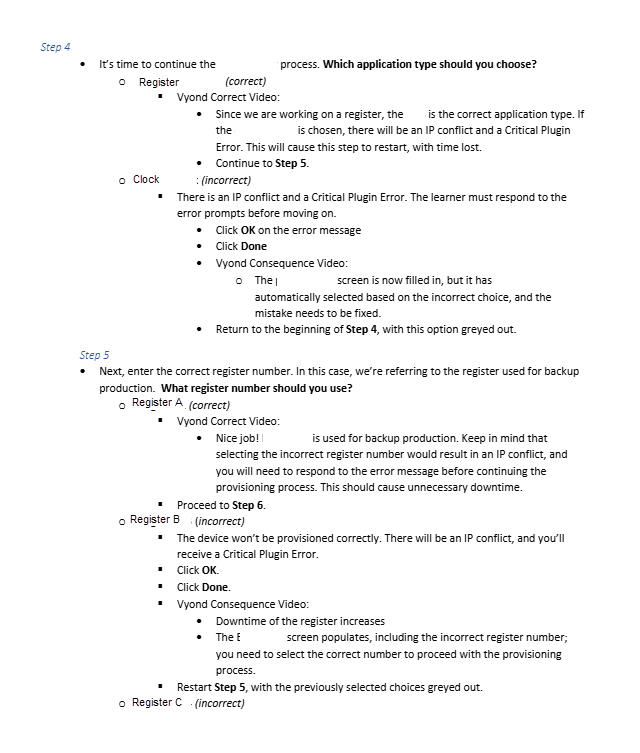
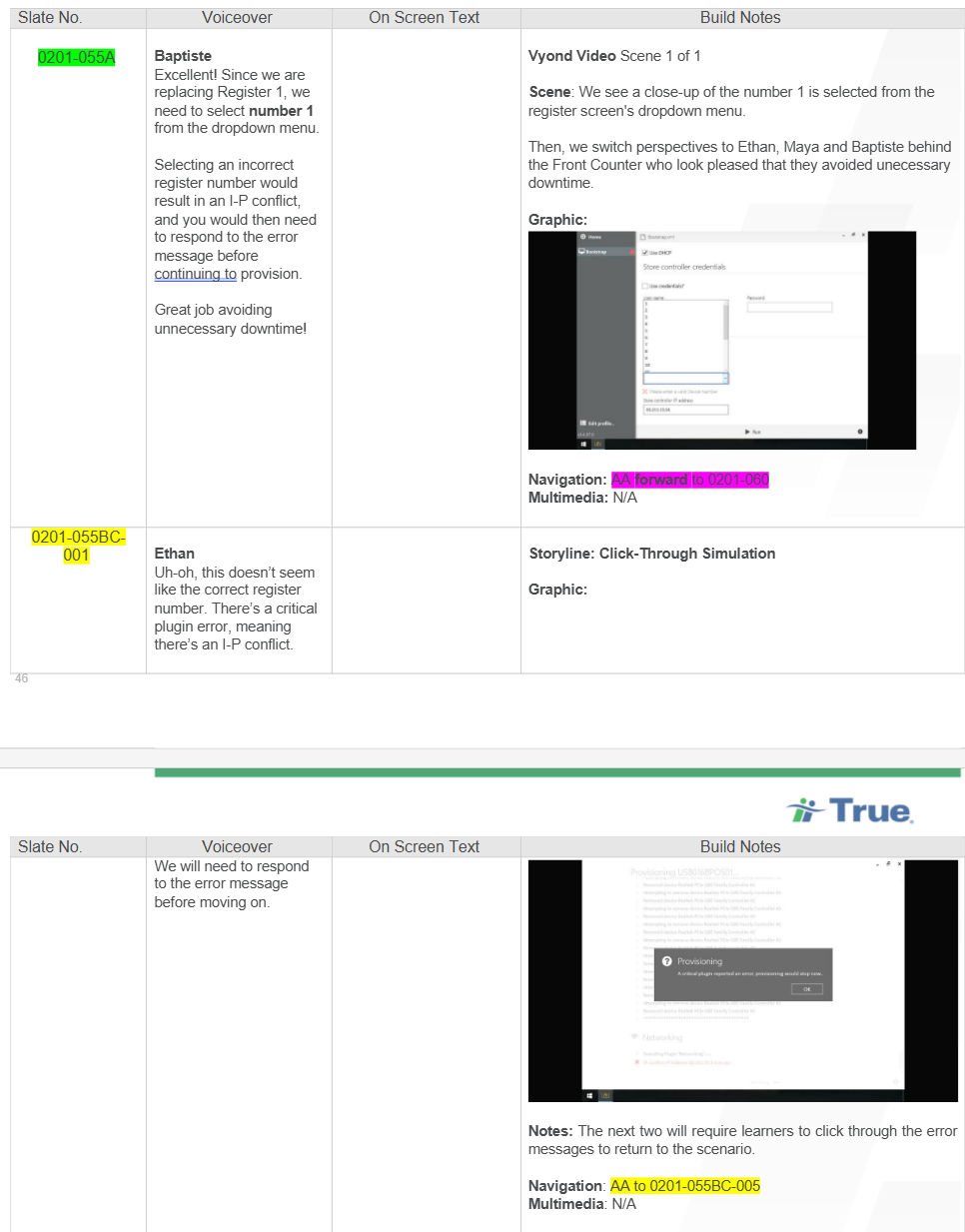
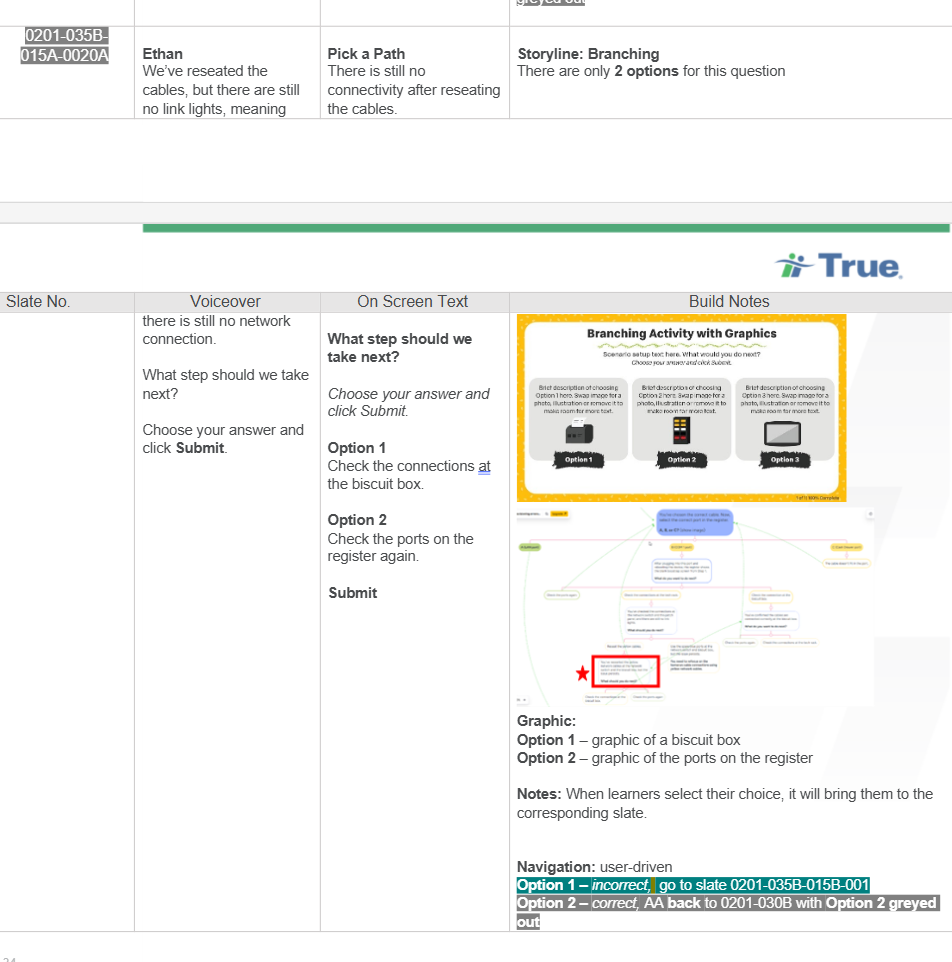
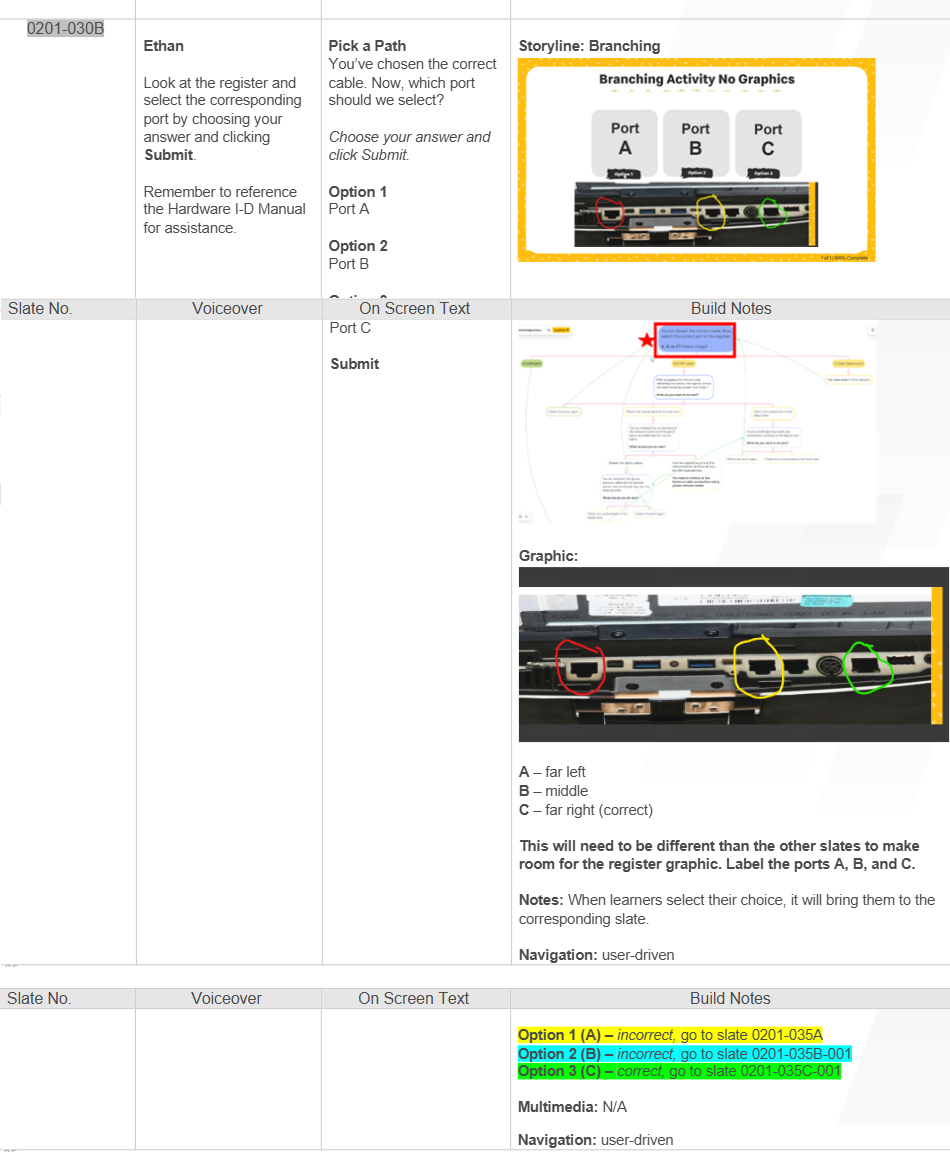
I created a detailed storyboard that translated the approved design into build-ready guidance for graphics, animation, and development. The storyboard included notes for navigation, on-screen text, voiceover, learner interactions, and interactivity, ensuring the full branching experience was clearly defined and decodable before development began.
Because this was the organization’s first branching-style module, I established a new internal standard for documenting branching logic. I introduced a color-coded, alphanumeric slate system to distinguish correct, incorrect, and recovery paths, and to direct navigation between decision points and consequences. This structure helped the development team quickly understand how learner choices flowed through the experience, reducing confusion during the build.
To support efficient implementation, I designed the storyboard with the needs of the graphics and development team in mind. I used clear callouts to indicate animation and authoring tools, provided detailed visual and animation notes, incorporated SME-provided screenshots for simulation steps, and embedded excerpts from the action–consequence flow to orient developers within the broader logic of the module.
Review Cycles
Once the module was built, I was responsible for reviewing it for functionality, accuracy, and overall learner experience. I served as the primary point of contact for feedback across four review cycles: alpha, beta, internal final, and client final.
During each round, I gathered input from SMEs, senior instructional designers, developers, internal stakeholders, and the client. I synthesized and prioritized feedback, clarified conflicting input, and determined what should be actioned, deferred, or discussed further. This helped keep reviews focused and ensured changes aligned with the original design intent while staying within scope and timeline.
Key Takeaways
This project established a new approach to scenario-based learning within the organization, introducing branching-style design and new documentation standards to support complex troubleshooting training. Through close SME collaboration, intentional design decisions, and clear communication with cross-functional partners, the module delivered a realistic, performance-focused learning experience.
For me, this project reinforced the value of designing from real-world behavior, designing in ways that support both learners and developers, and leading a project through collaboration, clarity, and thoughtful judgment.
Graphics & Development Collaboration
I worked closely with a graphics designer and eLearning developer to bring the storyboard to life. We met early and more often than our typical module together to walk through the branching logic and overall flow, ensuring shared understanding before development began.
Throughout the build, I collaborated with both partners to answer questions and clarify design intent as needed. This ongoing communication helped maintain alignment between the storyboard and the final experience while allowing the team to work efficiently and confidently.